New Launch


Your court case.
Your language. Your phone.
We've spent three years building AI tools inside India's courtrooms. Today, powered by Anthropic's Claude, we're bringing that work directly to citizens. Introducing India's first AI-powered national case information helpline on WhatsApp.
Powered By

Why We Built This
Courts have an information crisis. Citizens pay the price.
Walk into any district court in India and you will see a familiar scene. Dozens of families standing quietly at the back of the courtroom, confused and anxious, with no idea when their case will be called or what happened in their last hearing. Most leave without understanding a thing.
The information exists, technically. But it is locked behind court websites that are slow, non-intuitive, layered with CAPTCHAs, and overwhelmingly in English. Court orders are written in formal legal jargon that even lawyers struggle to parse. For a Kannada-speaking farmer or a Hindi-speaking daily-wage worker, these documents might as well not exist.
This information asymmetry is not just inconvenient. It is structurally unjust. It leads to missed hearings, unnecessary adjournments, and a deep sense of powerlessness among the people the court system is supposed to protect. Millions of families experience real anxiety navigating a system they cannot understand.
We have spent 18 months building tools that make courts more productive from the inside: transcription, workflow automation, judge productivity dashboards. But productivity gains inside courtrooms ring hollow if citizens outside them still cannot access basic information about their own cases.
The helpline is our answer to that gap. It is our first citizen-facing product, and it is built on a simple conviction: access to justice starts with access to information.
How It Works
A court clerk in your pocket. Available 24/7.
The helpline runs on WhatsApp, the platform over 500 million Indians already use every day. No app to download, no website to navigate, no login to remember. If you can send a WhatsApp message, you can use this.
You start by choosing your language. You share your name. You tell the system how to find your case by case number, party name, advocate name, or diary number. The system fetches real, live data from the appropriate court and presents it in a clean, conversational format.
We meet India’s data localization and sovereignty requirements.Check your case status—current status, full history, party details, next hearing date and purpose, all in plain language
Check your case status
Current status, full history, party details, next hearing date and purpose, all in plain language
Download and understand orders
Get AI-generated summaries that explain what was decided, what it means for you, and what happens next
Read it in your language
Court orders translated from English legal jargon into Hindi, Kannada, Malayalam, and more languages coming soon
Ask questions in your own words
"When is my next hearing?", "What happened last time?", "What does 'counter affidavit' mean?"
Get automatic alerts
Receive WhatsApp notifications when hearing dates change, orders are uploaded, or your case status shifts
We meet India’s data localization and sovereignty requirements. The helpline is built entirely on publicly available court data. No confidential judicial information is transmitted through the system.
The Intelligence Layer
Powered by Anthropic’s Claude
A court order on a land dispute might run 15 pages of dense, formal English. For the person whose land is at stake, it is incomprehensible. They cannot prepare for their next hearing. They cannot hold their lawyer accountable. They cannot make informed decisions about their own case.
The helpline’s AI layer takes those orders and produces clear, actionable summaries: what was decided, what the litigant needs to do, and when. It translates them into the user’s language. It answers follow-up questions conversationally. And it does all of this without inventing facts. The system strictly condenses what is already in the document.
Every summary comes with a clear disclaimer that it is AI-generated and that the official court order remains the authoritative version. We are building for trust, not spectacle.
Both the intelligence layer and the agentic layer of the helpline are powered by Anthropic’s Claude. We have been building and refining this system for months, and we chose Claude after evaluating multiple large language models because accuracy in legal summarization is not optional. In our domain, a misstatement can mislead a vulnerable person about their own case.
We also use Claude Code across our engineering team. It has fundamentally changed how we build, allowing a small nonprofit engineering team to operate at a pace and breadth that would otherwise require a significantly larger headcount.

Summarization
Dense legal orders condensed into clear takeaways. What was decided. What it means. What comes next.

Multilingual Translation
English legal jargon rendered in Hindi, Kannada, Malayalam with 10+ Indian languages on the roadmap.

Privacy by Design
Built entirely on publicly available court data. No confidential judicial information is transmitted through the system.
A New Chapter
From inside the courtroom to the people outside it.
Adalat AI has always worked at the institutional layer, building tools for judges, stenographers, and court staff that make courtrooms more productive. Our transcription platform, productivity dashboards, and workflow systems are live in over 4,000 courtrooms across nine Indian states. We have secured India's first statewide judicial AI mandate in Kerala and demonstrated real productivity gains.
But the mission has always been larger than courtrooms. We exist because justice delayed is justice denied, and the people who suffer most from delay are the poorest and most vulnerable: the undertrial prisoner, the farmer in a land dispute, the worker waiting for unpaid wages.
The WhatsApp helpline is our first step toward serving them directly. If we can make the system faster from the inside, we can make it legible from the outside. That is the full picture of access to justice.
What Is Ahead
Nationwide on Day 1. Deepening with state partners.
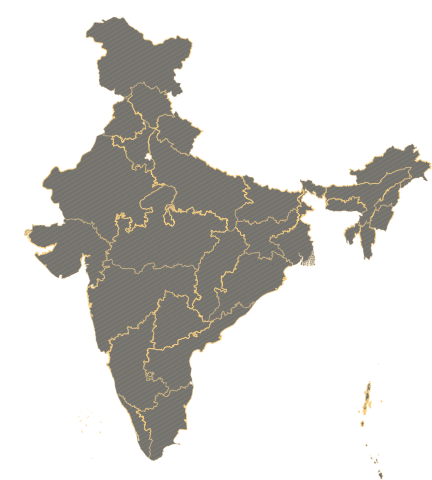
The helpline works across all Indian states from launch, pulling from publicly available court data. We are building deeper integrations with state court systems to enable proactive push notifications: automatic WhatsApp alerts when hearing dates change, orders are uploaded, or case status shifts.
We are expanding language support to 10 or more Indian languages. And if the model works in India, a system with 50 million pending cases, 22 official languages, and vast variation in infrastructure, it can work anywhere. We are already in early conversations about expansion to common-law jurisdictions across Africa, South Asia, Southeast Asia, and the Pacific.
Read the full story
Anthropic has published a detailed case study on how Adalat AI uses Claude, both internally for engineering and externally for the WhatsApp helpline, to accelerate justice technology in India.
Try it.
If you or someone you know has a court case pending in India, the helpline is live now on WhatsApp. It is free. It is in your language. And it takes 30 seconds.