Gokul Krishnan, Siddhant Pengoriya, Utkarsh Saxena
Policy
15
min read
The Paper Court: What 50 Million Pending Cases Look Like from the Ground (Part I)
50 Million cases are pending in India’s district courts. The usual explanation begins with too few judges. But spend time inside a courtroom and another constraint becomes impossible to miss: almost everything the court does must first become a written record. Testimony must be typed, orders transcribed, languages translated, handwriting deciphered and files physically moved from one desk to another. The Paper Court follows this largely invisible machinery — and the people keeping it running.

Spend an hour in any district courtroom in India and count how many times someone writes something down.
A witness finishes speaking. The courtroom falls quiet. Everyone waits as an untrained typist works through the answer on a keyboard, one key at a time, trying to turn what was just said into the official deposition. Proceedings move at the speed of the person producing the record. It can feel as though someone has taken the entire courtroom and deliberately set it to 0.5x.
Elsewhere, a judge dictates an order for a stenographer to take down in shorthand and type later. In a courtroom without a stenographer, the judge must either adjourn the hearing or take on the role of the scribe. A clerk updates the court diary by hand. Summons are drafted. Case files are annotated. The causelist is printed and pinned to a noticeboard. In the records room, a peon hunts through bundles tied with red thread for a file that may or may not still be legible.
You will lose count. Because that is what a court fundamentally is: a machine that converts speech and dispute into authoritative written text. A hearing is a writing event. A case is, in the end, a stack of documents. Nothing a court does – no bail granted, no property partitioned, no sentence passed – exists until it is written down.

Storage of case-files and paperwork across courts in (clockwise from top-left) Andhra Pradesh, Madhya Pradesh, Odisha and Uttar Pradesh.
We almost never think about courts this way. The public conversation about judicial delay is about judges, and rightly so: India's district courts carry more than 5 crore (50 million) pending cases, 48 lakh (4.8 million) of them pending for over a decade, and India's judge-to-population ratio of 22 judges per million people sits far below the Law Commission's recommended 50 judges. But look past the judge’s chair and you find that an enormous share of what slows a court down is not a shortage of judgment. It is a shortage of writing – of hands to write, of legible records, of text that can be found again once it is produced.
For almost three years, our work at Adalat AI has taken us inside district courtrooms and into conversations with judges, stenographers, clerks and the support staff who keep the system functioning. ‘The Paper Court’ is a two-part account of what we saw – the minute frictions in the pipeline that often go unnoticed but contribute to the crisis of judicial pendency. Part I follows what happens after a witness speaks – how testimony and orders are recorded and converted into official documents. Part II steps outside the courtroom to examine selected points in the administrative life of a case – how matters enter the court system, move through its offices and are eventually communicated beyond it.
From speech to shorthand and back to paper – the making of the court record
A judge does not merely hear a case but also records and preserves what happened. Witness testimony, directions issued during hearings, and the court’s eventual judgment – all become part of an official record – one that lawyers can rely on, an appellate court can examine and a future judge can understand. But how do these spoken words become part of the case file? Consider the example of a judicial order.
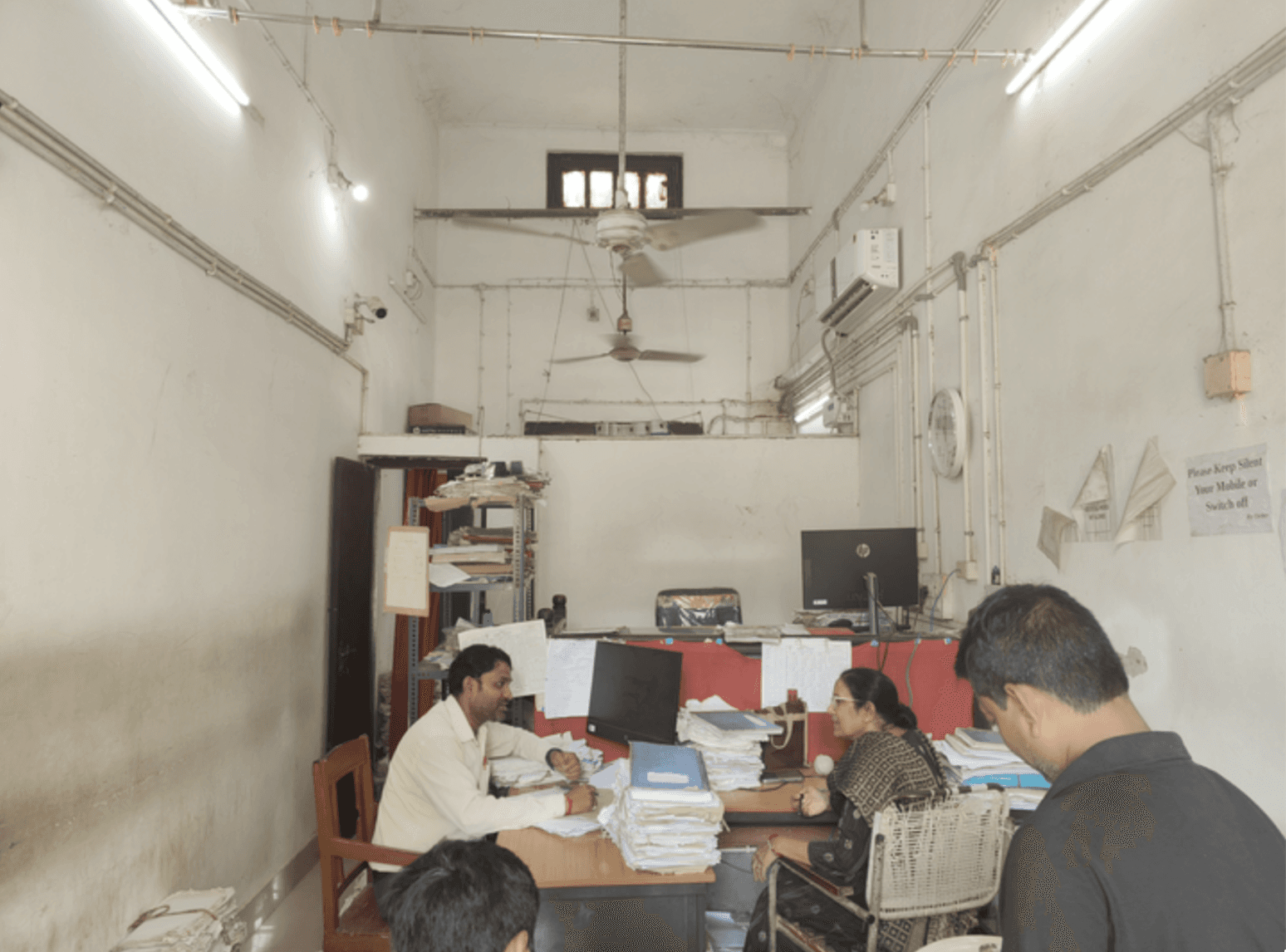
A classic Indian district court setup – with the judge’s dais, seating for the court master/bailiff and the stenographer under the judge and an endless stack of files.
Where adequate staff are available, the crucial intermediary is the stenographer. In some courts, the stenographer or typist directly types the judge’s words onto a computer. However, in most courts, the record passes through multiple stages before it is finalised:
The steno captures the judge’s dictation in shorthand – a specialised system of symbols and abbreviations that allows them to write at close to the speed of speech.
The stenographer then expands the shorthand into a typed document.
This draft is returned to the judge as a printed copy, who reviews it and usually marks corrections on it by hand.
Those corrections are sent back to the stenographer, who retypes and prints the document again and returns it to the judge for signature or further corrections.
Our teams report that this back-and-forth review process can consume weeks before the final order is signed and uploaded.
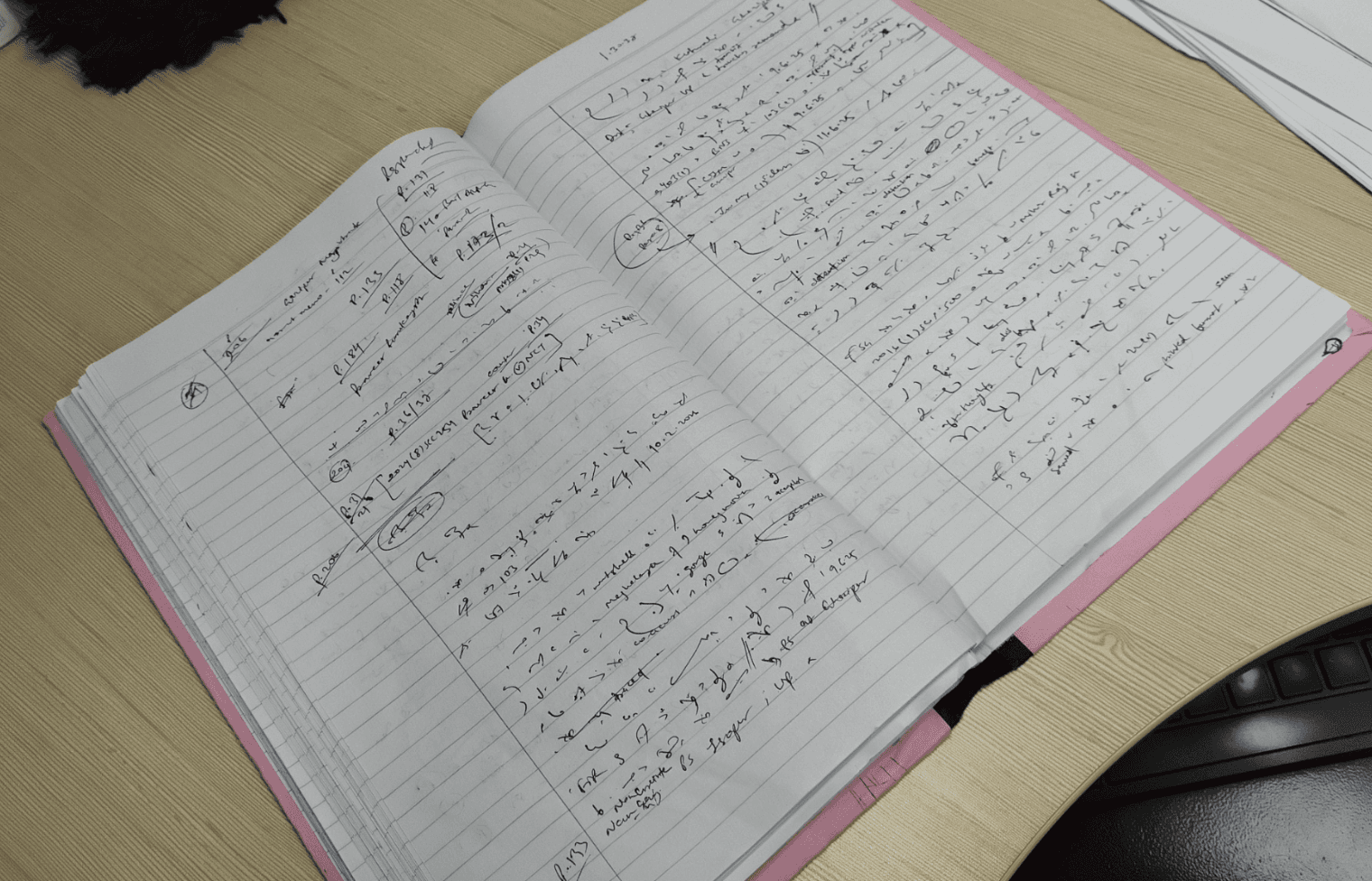
A stenographer’s register with court records in shorthand
What begins as spoken dictation thus travels repeatedly from shorthand to screen, from screen to paper, and from paper back to screen before becoming accessible to the litigant. Each conversion creates another version, another handoff and another point at which the record can wait. That is the process when the system is working as intended. Even this cumbersome arrangement depends on a resource many courts do not have: a stenographer.
Judge becomes the stenographer – and justice comes at the speed of their pen
Stenographic staff are embedded in the ordinary functioning of the Supreme Court and High Courts. A dedicated stenographer is also a familiar presence in many metropolitan district courts. As one judicial magistrate from Delhi mentioned to our team –
"At the beginning of every year, my stenographer and I sit down together and compare our calendars. I note when she plans to take leave, and I plan my own leave around those dates. It is impossible for me to work in court without her."
This is how indispensable a stenographer is to the functioning of a courtroom. Judges accustomed to working with dedicated stenographers in metropolitan courts can find it nearly impossible to function without them.
Beyond these metropolitan centres, however, our visits revealed a far more uneven picture. The shortage of stenographers in some courts is so severe that judges are forced to become scribes themselves – recording testimony by hand so that proceedings can continue and the judicial record can exist at all. The court keeps moving, but at an enormous cost to both judicial time and the quality of justice.
Abhishek Jha, our Bihar lead, recalls a visit to a district court in the state –
"Several judges had no dedicated stenographer and wrote out depositions and orders by hand. One judge remarked, with a smile, that by the end of almost most working days, it felt as though he had just finished writing a Class 10 board examination paper. We have been appointed to judge, but large parts of our day are spent acting as scribes."
A Daksh-Vidhi study of district courts in rural Bengaluru found only 27 of 91 sanctioned stenographer posts filled – a vacancy of over 70%.
The shortage has become absurd enough to enter the case law itself — a Debt Recovery Tribunal once dismissed an application citing the lack of stenographers and typists, an order the Punjab and Haryana High Court had to reverse. Think about what that order actually meant: a citizen’s case was thrown out because there was no one available to write!
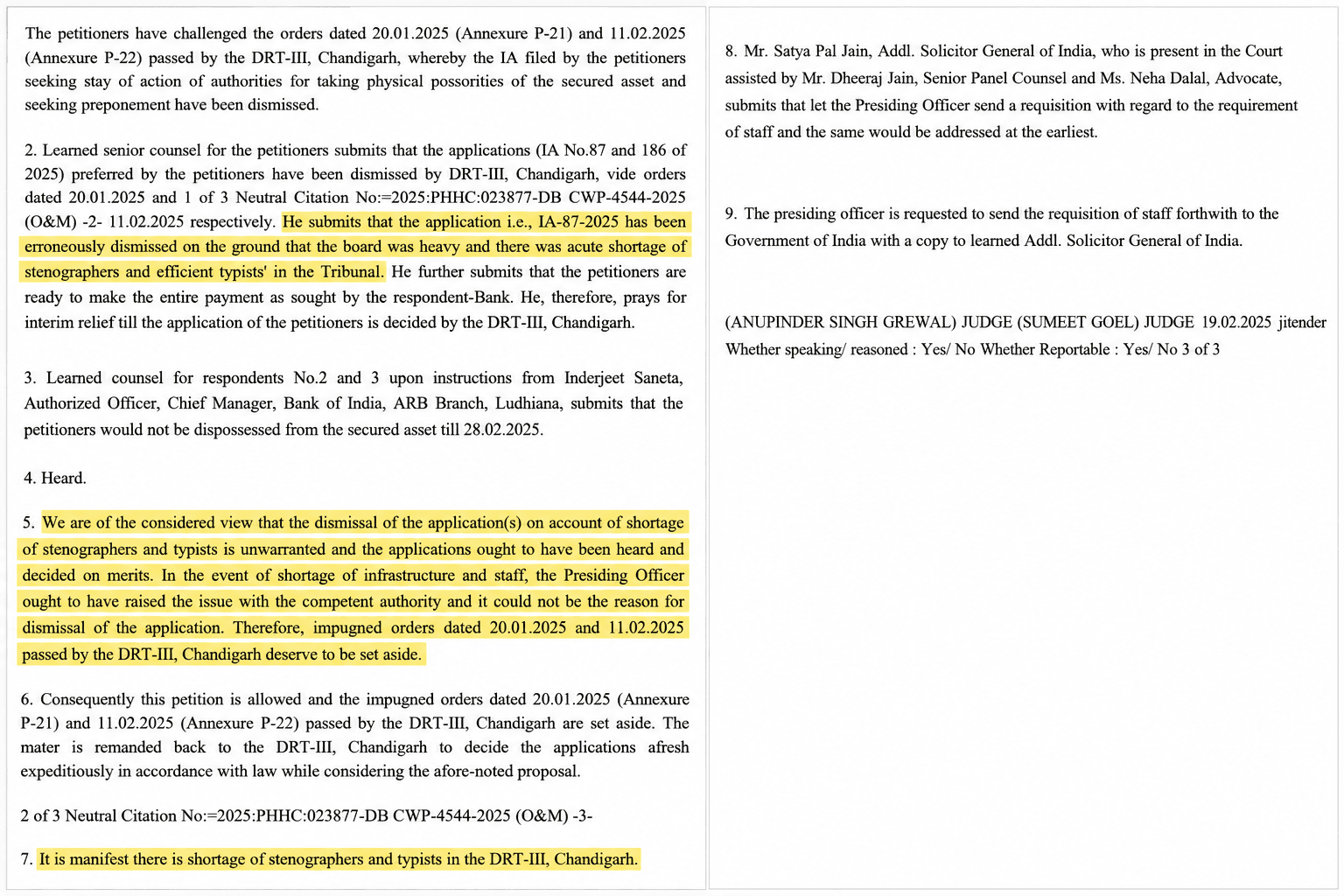
Order of the Punjab-Haryana HC in Sarabjit Singh v. DRT III (19.02.2025) (referred above)
These steno shortages directly impact the pace at which the judiciary moves and pending cases are cleared. As this Indian Express article reports:
“For more than 10 months now, the Tribunal-cum-Labour Court-1 at the Karkardooma Court Complex in Delhi has been without a stenographer, who is required to take down judgments by the presiding officer. Consequently, Judge R K Yadav has been unable to pass the final orders in more than 80 cases, though the arguments have been concluded…The government cannot create tribunals and then refrain from providing staff for it. How is a judge supposed to work if he does not even have a stenographer?”
In October 2025, a Supreme Court Bench led by Justice Surya Kant – now the Chief Justice of India – was confronted with an even starker example. More than 800 matters had already been heard, but judgments were reportedly delayed because the Jammu Bench of the Central Administrative Tribunal had only 1 stenographer to assist its judges.
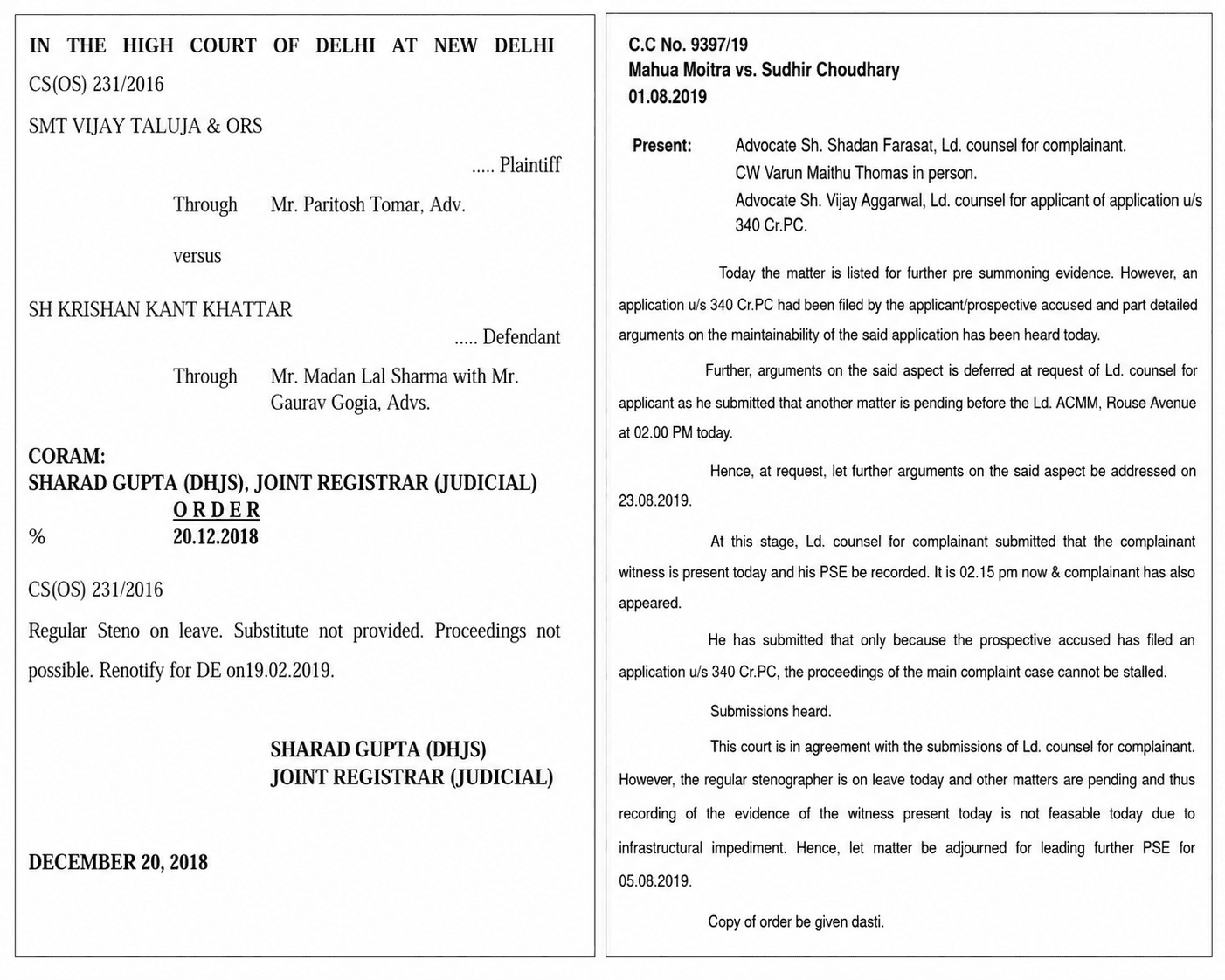
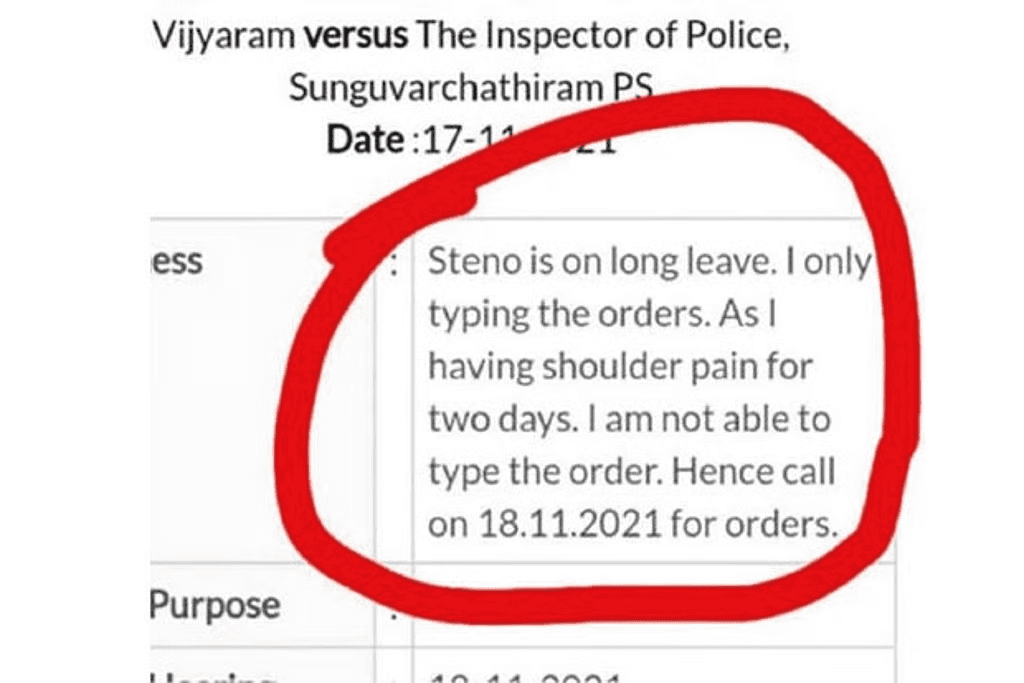
Examples of other cases where the absence of stenographers was explicitly recorded as a reason for delays in court proceedings. Last image reproduced, as reported in this DT Next article.
The immediate consequence of such shortages is delay: when judges must record every answer themselves, testimony can proceed only as quickly as they can write or type. But the burden goes beyond time. A judge must also listen to the witness, rule on objections, observe demeanour and assess each answer in context. Producing the record at the same time divides that attention, potentially affecting both the record and the evaluation of the evidence.
There is also a human cost to all this that rarely makes it into policy documents. For one judge in a Patna district court, years of writing out every testimony, deposition and order by hand have left him with spondylitis. He recounts:
“We don’t have a stenographer. Not even a deposition writer. Those are rare. Maybe some senior additional judges get one – but not us.”
As another district judge from Kerala highlighted, writing this much by hand, day after day, takes a physical toll on judicial officers and staff — aching hands and strained eyes simply become part of the job description of Indian justice.
The many languages of a courtroom
Writing is only one part of the conversion. Before a witness’s spoken answer enters the case file, it may also have to cross a language.
Indian courtrooms routinely bring together different linguistic worlds. A witness may testify in a regional language or local dialect; the official language of the court may be another; and the judge may have received much of their legal education in English. Recording evidence requires someone to move constantly between them – often while the examination is still underway.
As reported by the Print, a district court judge from a Hindi-speaking northern state described the difficulty:
“We’re trained mostly in English, but all depositions are to be written in Hindi. When you’re writing fast, the handwriting slips. And if you’re writing fast in a language you’re less fluent in, it gets worse.”
The law recognises this problem. In such situations where the witness gives evidence in a different language than that of the court, Section 312 of the BNSS (erstwhile Section 277 of CrPC) stipulates that the testimony may first be recorded in the language in which it is given and then translated into the language of the court. If that is not possible, a “true translation” must be prepared as the witness is being examined.
But complying with this framework requires stenographers who can record multiple languages, or trained interpreters capable of translating evidence as it unfolds. However, we found that such support is often unavailable due to the shortage of translators in court. As this South China Morning Post article reports:
“The court was in session just two hours, as it is every day of the trial. Only one witness - out of nearly 100 called in the case - had time to testify. The judge himself translated the testimony sentence-by-sentence from Hindi into English, and carefully corrected the court stenographer’s errors. “That’s not how you spell SIGN”, the judge admonished, as assembled reporters and police nodded off in boredom.”
Ramya, our Andhra Pradesh lead, highlights another less-recognised barrier that judges often complained about during court visits:
"Often the problem isn’t language but dialect. Judges are usually posted far from their home region, so they struggle to follow witnesses – sometimes even the advocates. And by the time a judge grows comfortable with the local dialect, a year or two in, she’s transferred."
Judicial translation is not simply a direct conversion from one language to another. As legal scholars have noted, it requires careful attention to legal terms and concepts that may shape the outcome of a case. When untrained judges, lawyers or court staff act as interpreters, a mistranslated phrase can alter the evidence on record and lead to serious legal consequences.
In one murder case in Maharashtra, the difference between life and death turned partly on a mistranslated sentence. A witness testified in Marathi that the accused "did not intend to kill us." However, the translated English record – “It is not true to say that the accused did not have intention to kill us” – meant the exact opposite because of the inserted double negative. The trial court sentenced him to death, only to be reduced to a life sentence by the Bombay High Court that called the translation “absolutely wrong”.
Statement recorded in Marathi | Correct Translation | Incorrectly translated version in English |
|---|---|---|
“आरोपीला मी टोचून बोललयाने आरोपीने मला, माझया मुलाला व बिहणीला मारले. आमहाला मारणयाचा तयाचा हेतू नवहता.” | “Because I made a stinging remark to the accused, he assaulted me, my son, and my sister. He did not intend to kill us.” | “It is not true to say that the accused did not have intention to assault me or to kill my son and sister, following my unwarranted comments.” |
When jugaad becomes the system
The frictions described above rarely bring a court to one dramatic halt. Instead, they puncture its workflow at different stages: testimony stalls before it reaches the page; meaning is caught between languages; handwriting reaches the file but cannot be read. Courts cannot wait for more staff or better infrastructure – so they improvise. The result is a series of ad hoc solutions – which begin as a jugaad (popular Hindi slang for ‘frugal innovation’) – but gradually become part of the system itself.
The Fair Copy Section is one such workaround, adopted by district courts in some states. When a stenographer is unavailable, a judge may record a deposition by hand. But that record must outlast the person who wrote it. Judges retire, transfer and rotate between rosters, leaving their successors to work from handwriting that may be barely legible.
Because this problem recurs so routinely, case files in many courts are sent by default to the Fair Copy Section. There, a staff member rewrites the handwritten record – again by hand – in a clearer script. The absurdity is not that court staff perform unnecessary work. It is that the system has made this work necessary. In some states, the workaround has become sufficiently institutionalised for district court establishments to maintain a designated post of Fair Copy Superintendent.
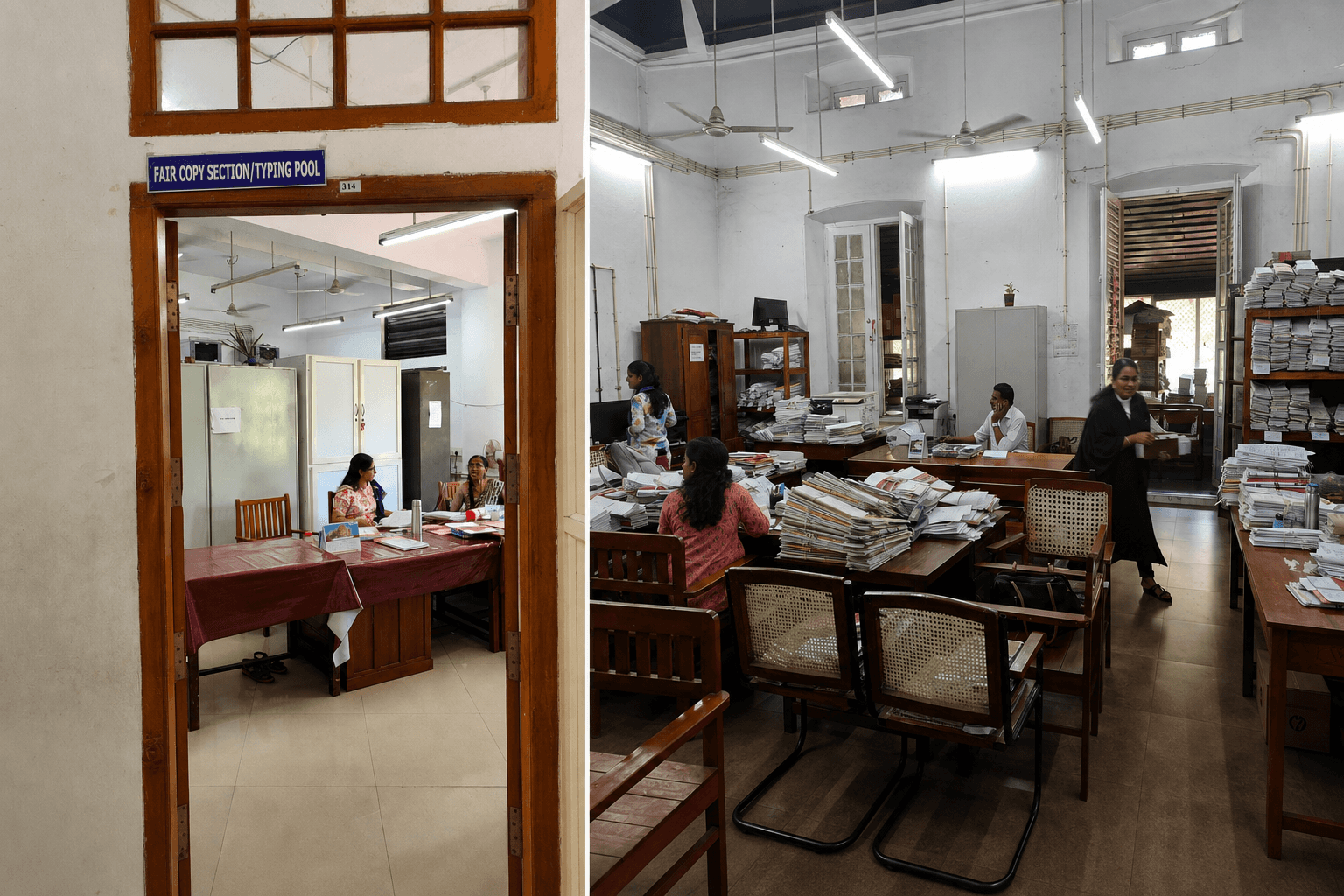
A fair copy department in a district court in Kerala.
Even this institutional workaround does not always resolve the problem. When a handwritten passage remains unclear, the formal solution gives way to an informal one. In some courts, judges and staff use WhatsApp groups to circulate photographs of difficult passages and seek help deciphering them. The query may even be sent back to the judge who originally recorded the deposition – and perhaps, has now even been transferred to a new district.
In this video documentary by The/Nudge Institute and Meta, one judge recalls, with some embarrassment, receiving such requests about depositions he had recorded the previous year:
“Sometimes they take photographs of the handwritten notes and send them to me on WhatsApp, asking, ‘Bhaiya, what does this say?’”
Together, the Fair Copy Section and the WhatsApp groups illustrate how courts respond when the formal process fails. One solution creates an additional institutional layer; the other creates an ad hoc channel outside the institution altogether. Both keep the record moving, but their costs are distinct.
Recopying all depositions demands more time, labour and paper. It also requires the record to pass through more hands and exist in more versions. With every additional transfer, the risk of error compounds: words may be miscopied or omitted, pages misplaced, and records or versions mixed together.
The WhatsApp ecosystem presents a different danger. When photographs of depositions are shared through personal phones, sensitive witness statements, and confidential judicial records leave the court’s supervised systems. The court has little control over who receives them, where copies are stored or how long they remain on devices and cloud backups.
These workarounds are a testament to the ingenuity of judges and staff who prevent an overstretched system from coming to a halt. But they do not remove the underlying friction. They build a second process around it – adding more hands, more copies and more points at which the record can be delayed, distorted or exposed.
Conclusion
This is the paper court – not merely a court that uses excessive paper, but one whose daily functioning depends on people compensating for paper’s failures.
None of this is an argument that judges do not matter or that vacancies on the bench are not the crisis they are. It is an argument about what a court actually is. We picture justice as deliberation – a judge weighing arguments. But between every act of deliberation sit a hundred acts of transcription, and the transcription is where the system is quietly buckling: too few hands to write, records that cannot be read, text that has to be produced 3 times to count once.
If we want to understand why 5 crore cases are pending – and where reform might actually bite – we have to start seeing the court for what it is: not just a place where justice is spoken, but the place where, word by word, by hand, it is written. Before our courts can move faster, the record itself must. In Part II, we step outside the courtroom to follow selected points in that journey – where records enter, move through and sometimes stall within the wider court system.