Siddhant Pengoriya, Ramya Dronamraju, Abhigna Pillalamarri, Bhavana Ganugula
Partnerships
15
min read
Andhra Pradesh Becomes Third Indian State to Mandate Statewide Adoption of Adalat AI
The Andhra Pradesh HC has mandated statewide adoption of Adalat AI, effective 1 October 2026 — bringing live transcription and case management to all 733 district courtrooms across the State. The mandate is the culmination of over two years of piloting, dozens of training sessions, and continuous product refinement shaped by judicial feedback. This post traces that journey: the preparation behind the mandate, our learnings along the way, and how we are gearing up for the statewide rollout in October.

On 27 July 2026, the High Court of Andhra Pradesh announced that the use of Adalat AI will be mandatory across all courts in the State’s district judiciary from 1 October 2026. The mandate covers live court transcription, case-flow management, and end-to-end court workflows, making it our broadest statewide mandate to date.
Andhra Pradesh is the third state, after Kerala and Sikkim, to move towards full-scale, mandatory adoption of Adalat AI. With effect from November 2025, the Kerala HC mandated the use of Adalat AI’s transcription tool for recording witness depositions in all courts in the State. In June 2026, Sikkim mandated electronic filing using Adalat AI’s end-to-end paperless court stack.
A Comprehensive Statewide Mandate
The mandate brings Adalat AI to 733 courtrooms across all 13 judicial districts in Andhra Pradesh. Its significance lies not only in this scale, but also in its scope.. It covers the creation and management of the judicial record both inside and outside the courtroom.
Adalat AI’s Live Court feature supports judicial work as proceedings unfold. It is used to record evidence and witness depositions during trials, as well as to record and dictate daily orders, interlocutory orders, final orders and judgments. Additionally, it supports call work, cause list management, and associated administrative tasks.
The Judge’s Chamber feature extends this support beyond live court proceedings. It enables judges to dictate lengthy orders and judgments from their chambers, transcribe recorded audio clips using the Dictaphone feature, and avail AI-powered research assistance using Legal Lens.
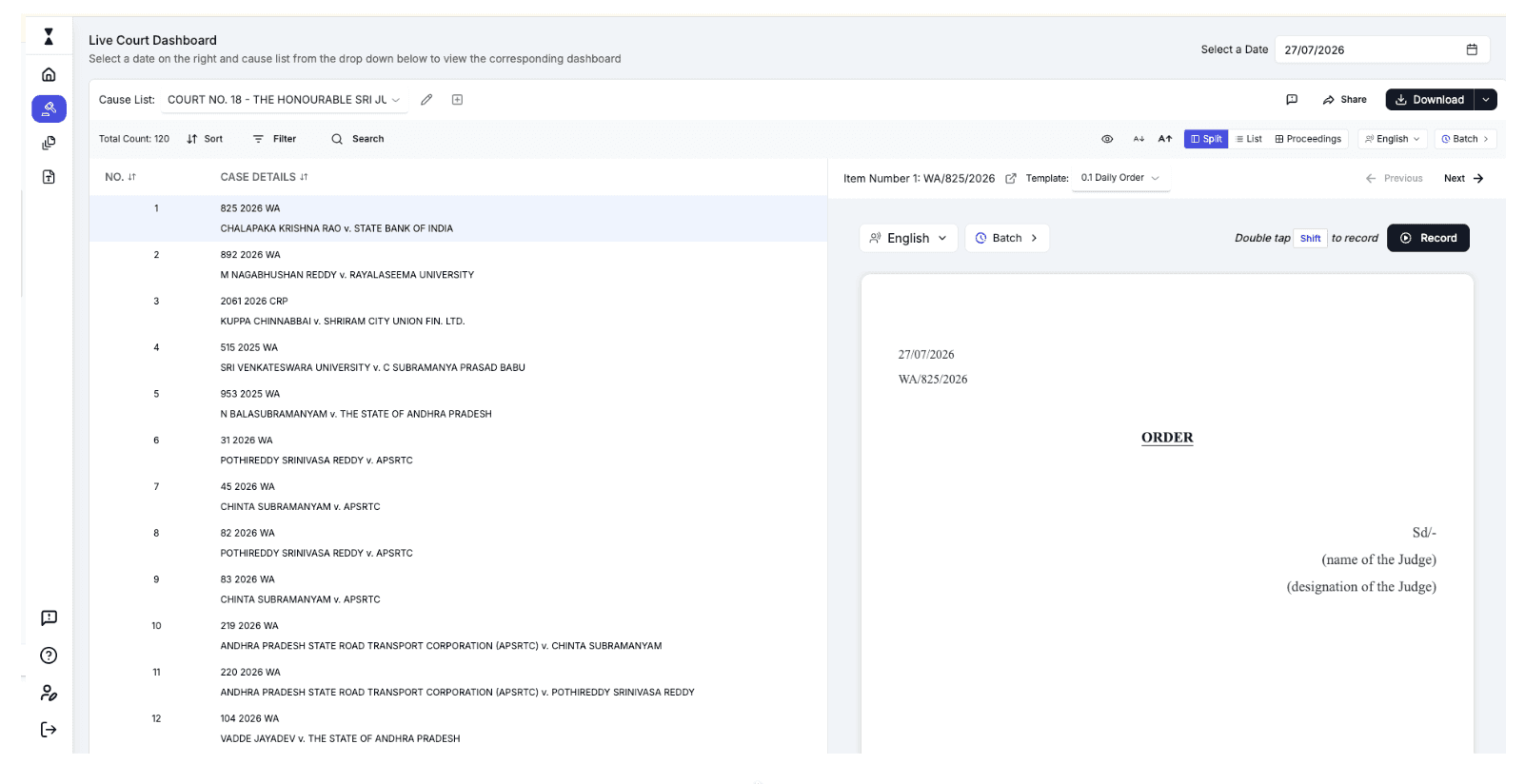
A live court dashboard with the given day’s cause list, a writing page with multiple state-specific templates and access to the dictation feature in different Indic languages.
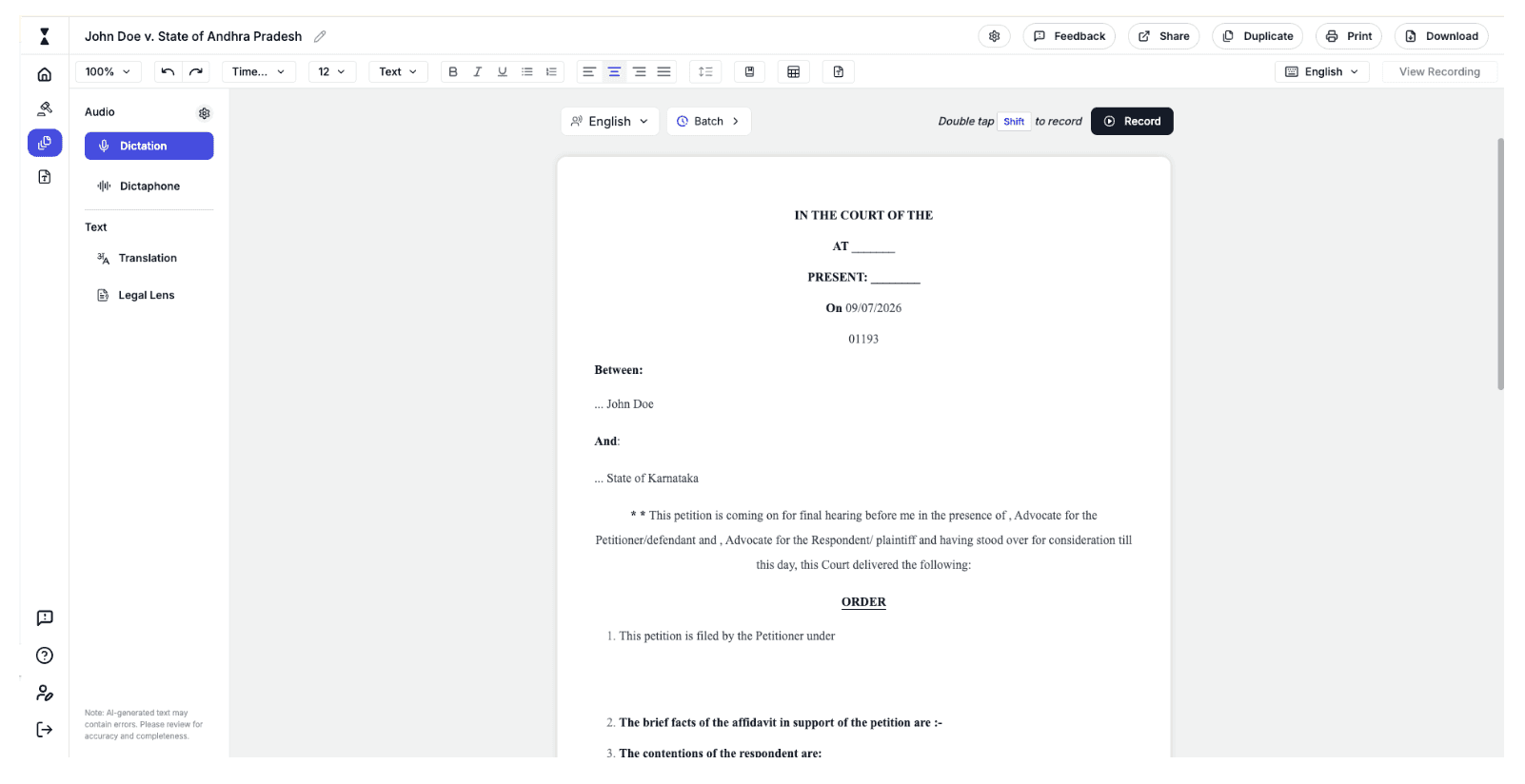
A Judge’s Chamber dashboard featuring Dictation (live transcription), Dictaphone (recorded speech-to-text), Translation and Legal Lens (AI-powered document search).
From Pilot to Mandate-Ready
The statewide mandate is the culmination of a phased process of piloting, testing, feedback and close collaboration with the judiciary. The first pilot began in 2024 with a small group of 6 selected judicial officers. Access was subsequently extended to all Civil Judges (Junior Division) across the State. In November 2025, the High Court launched a further structured pilot covering the Courts of Civil Judges (Junior Division) in Chittoor, East Godavari, Guntur and Srikakulam districts, while judicial officers in other districts could continue using the platform voluntarily.
The pilot was supported by in-person and virtual training of judges and court staff. Our teams conducted in-person sessions within court complexes and the Andhra Pradesh Judicial Academy – providing judges hands-on guidance on using Adalat AI in their daily work. We also organised virtual workshops and weekly Office Hours (with smaller groups of users) for troubleshooting, doubt-clearing and direct feedback. Hon’ble Justice Harinath of the Andhra Pradesh HC voluntarily presided over several of these Office Hours, sharing his own experience with the platform and encouraging fellow judges to make fuller use of it. Across the 2 years of the pilot, our teams conducted 38 training sessions and hosted 5 weekly Office Hours.
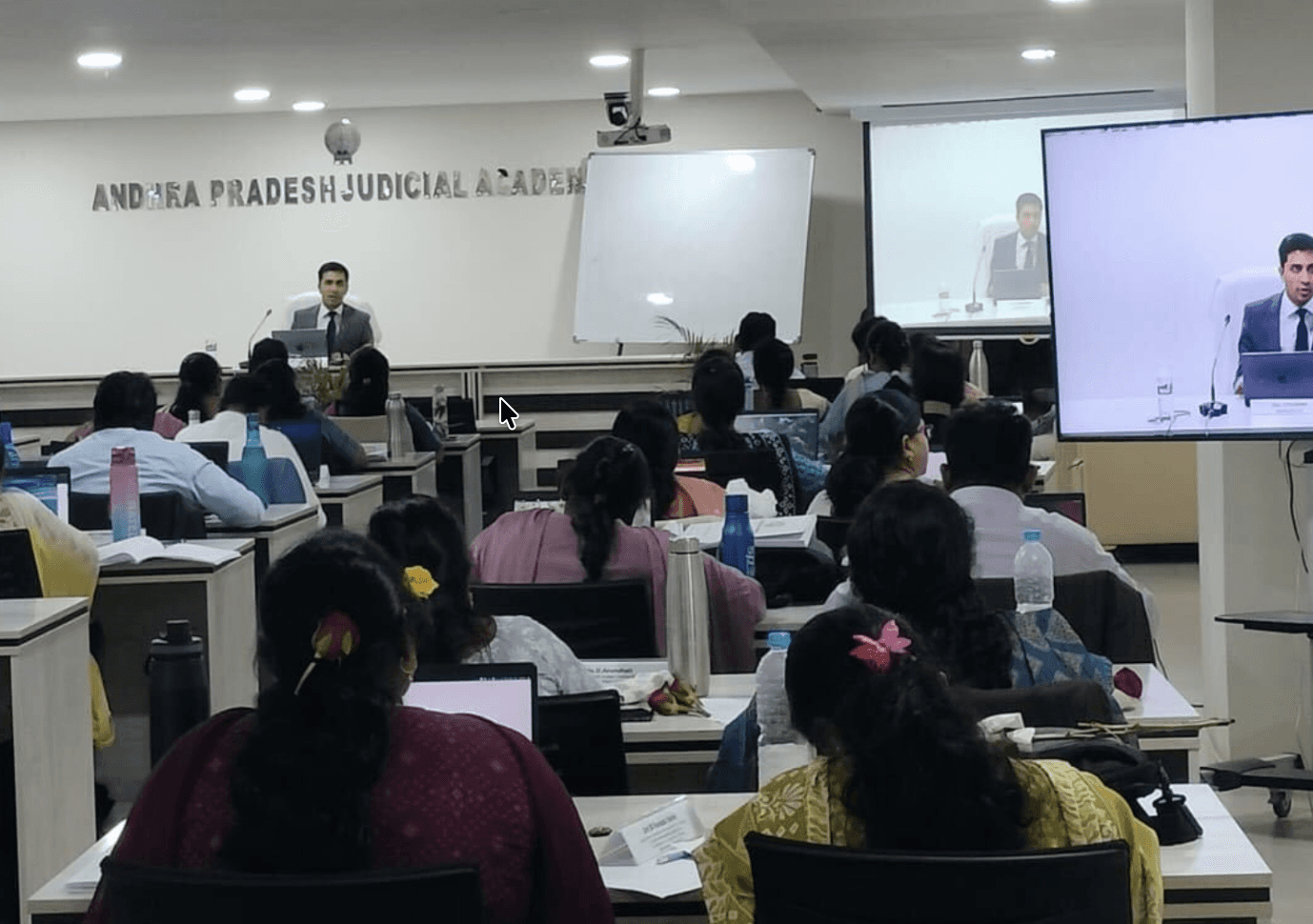 | 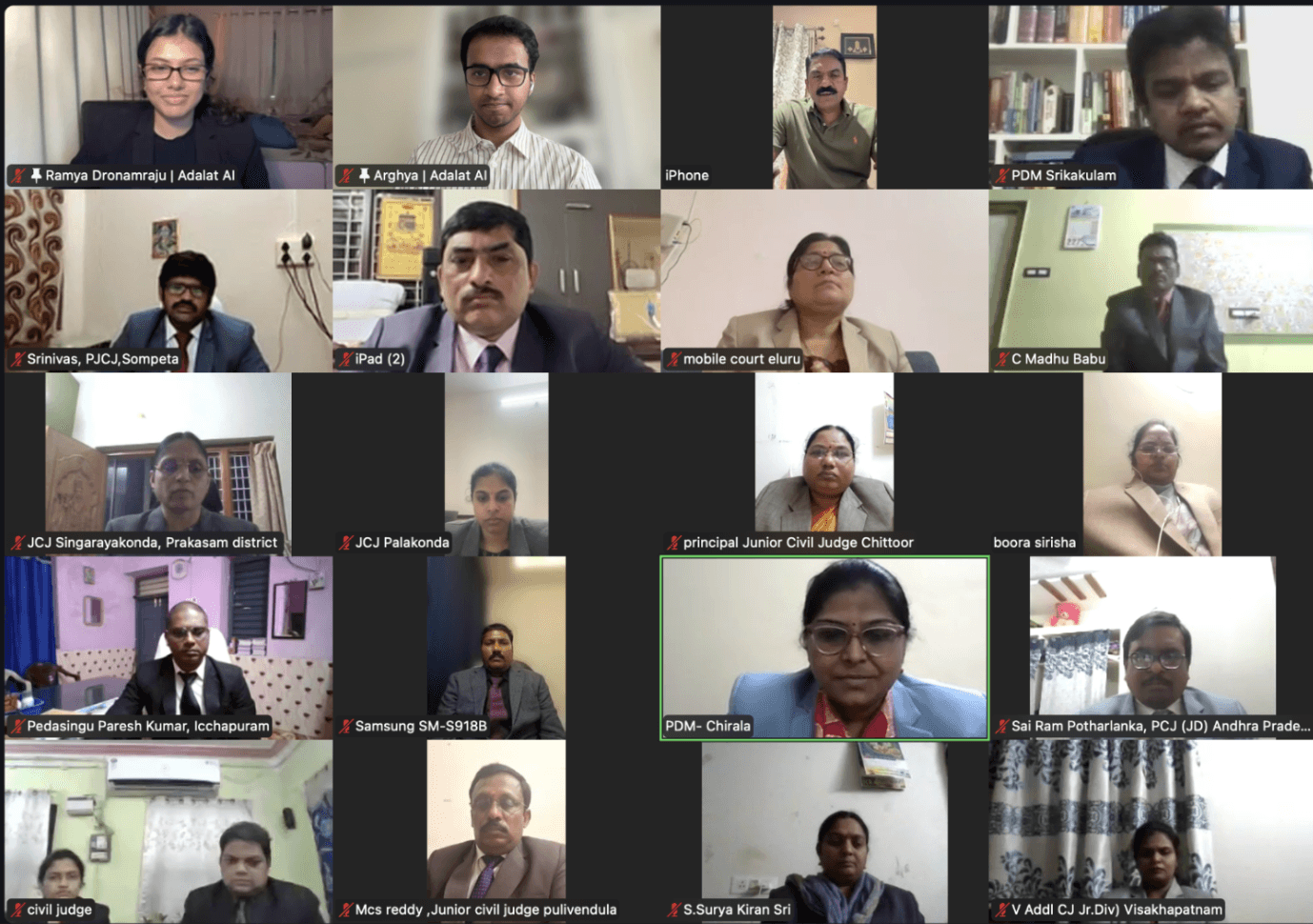 |
(Left) In-person training at the Andhra Pradesh Judicial Academy; (right) interactive virtual session with district court judges presided over by Hon’ble Justice Harinath.
Such pilots serve a dual purpose. They allow the judiciary to assess the platform’s accuracy, ease of use and alignment with actual courtroom requirements, which helps build trust and drive statewide adoption. At the same time, they help our product and implementation teams understand how judicial processes operate on the ground, identify the State’s unique needs and potential gaps, and determine the customisations required to improve uptake.
Adoption and Impact: The Pilot in Numbers
Nearly 2 years of usage data paints a clear picture of how Adalat AI was adopted across Andhra Pradesh. The chart below tracks 2 key measures of activity since the platform went live in October 2024: the number of minutes transcribed each month, and the number of unique monthly active users (MAU).
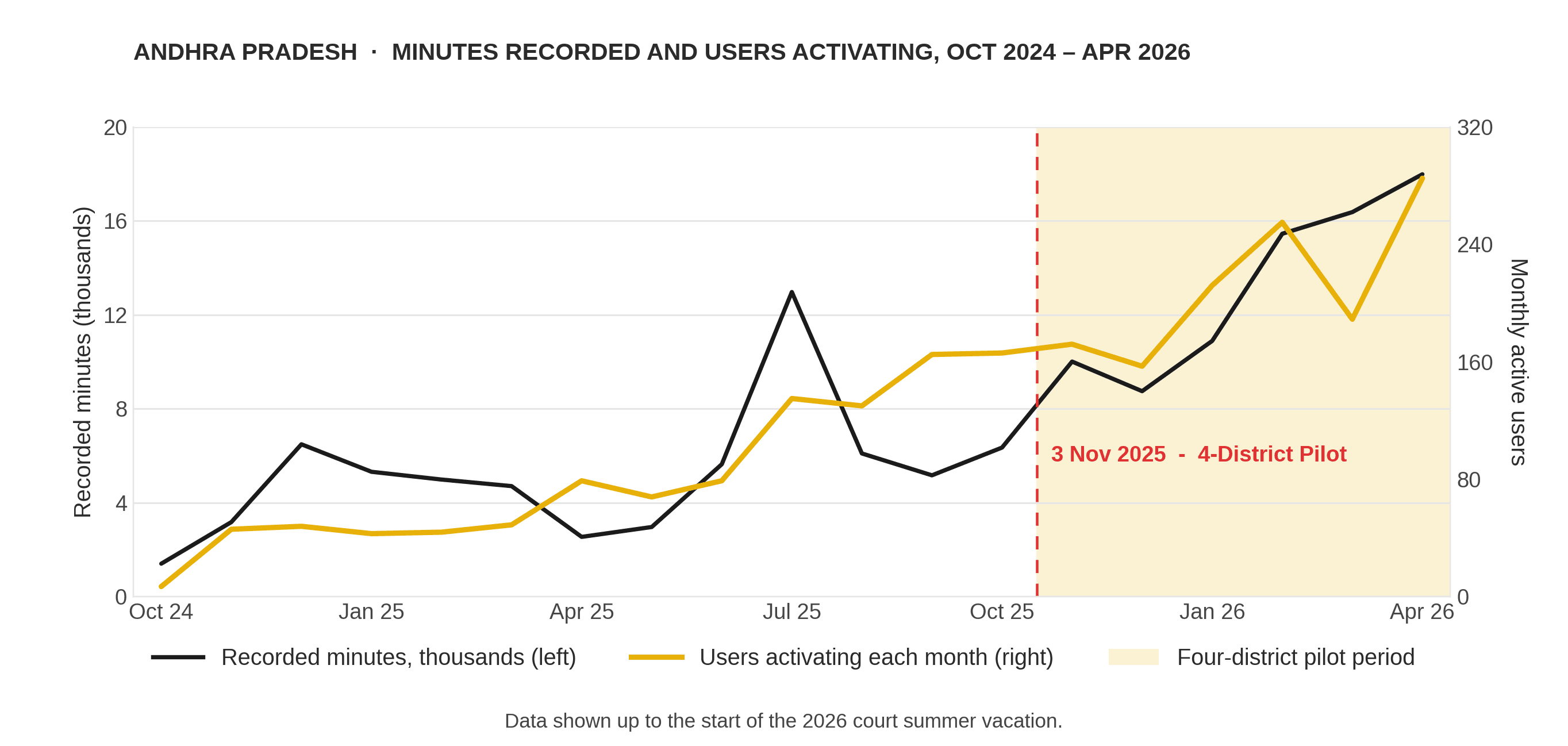
The chart indicates a steady and compounding growth over the period. Adoption accelerated from November 2025 (shaded region), when the structured pilot began in the 4 districts identified by the Andhra Pradesh HC. Usage peaked in April 2026, with 285 judges and staff actively using Adalat AI and 17,984 minutes transcribed that month. Furthermore, district-level usage data suggests that a good portion of this activity came from judges outside the 4 pilot districts who continued to use the platform voluntarily – evidence of organic growth.
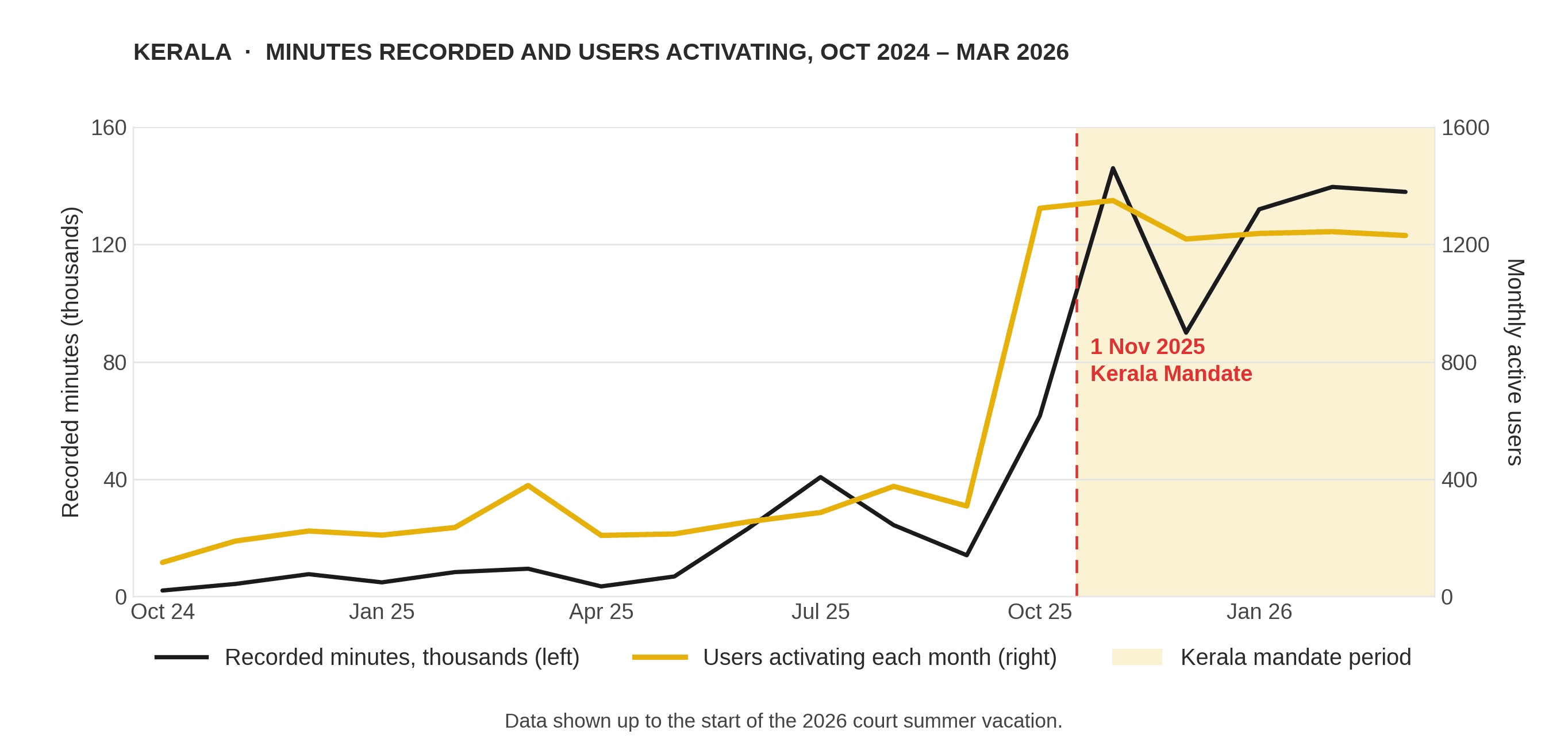
Experience from Kerala indicates how adoption can further accelerate once a mandate takes effect. Between September and November 2025, when Kerala’s mandate was implemented, the number of minutes recorded rose to 9.9 times its September level, while MAU increased fourfold. Usage has remained sustained since then. Although adoption patterns differ across States, Andhra Pradesh has the potential to demonstrate growth on an even larger scale because unlike Kerala, its mandate extends beyond live-court witness depositions to case-flow management and broader end-to-end court workflows.
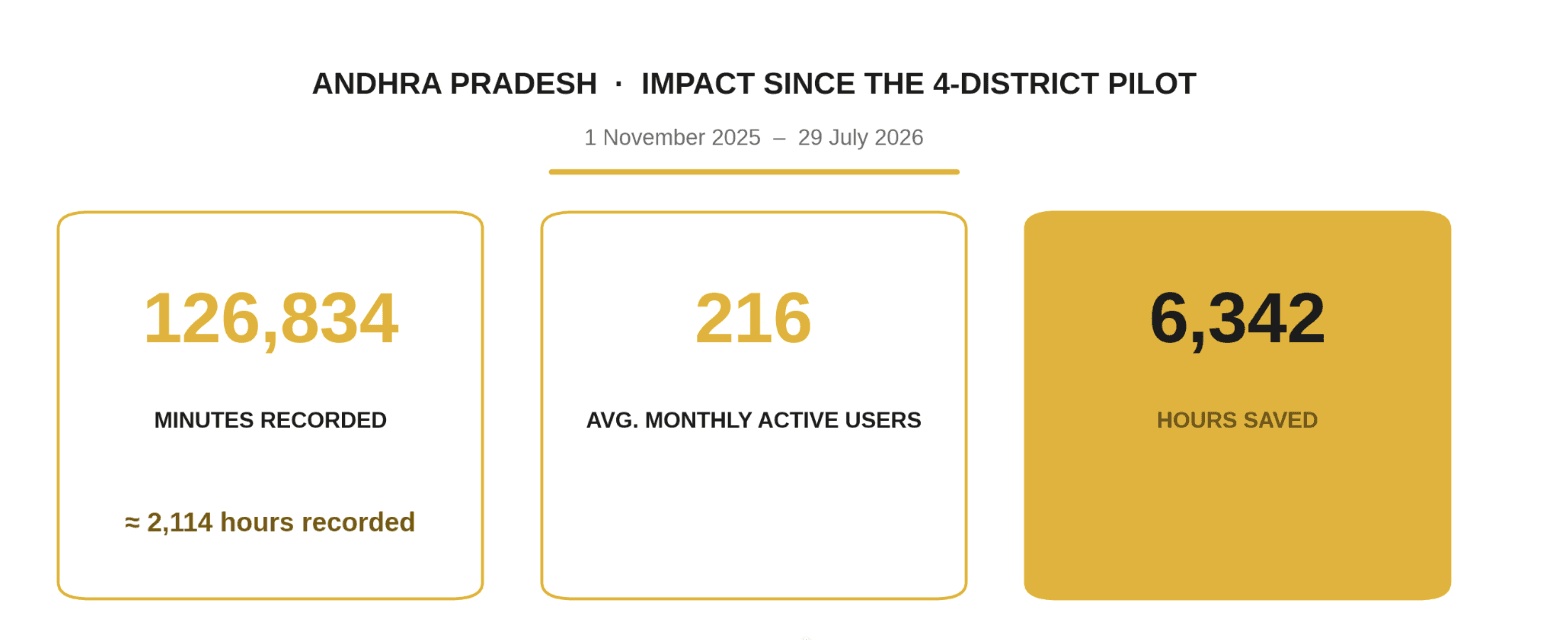
Even before the mandate takes effect, Andhra Pradesh’s own pilot has already produced meaningful scale. Aggregated across the period from 1 November 2025 to 29 July 2026:
Minutes recorded = 1,26,834 (≈ 2,114 hours)
Average Monthly Users = 216
Hours Saved = 6,342 hours*
*Based on an internal time-motion study, benchmarking the platform against manual transcription methods across 7 states, we found that every minute transcribed on Adalat AI saves roughly 3 minutes of manual work. Applied across the pilot's 2,114 recorded hours, that adds up to an estimated 6,342 hours saved for judges and court staff.
What the Pilot Taught Us – Learnings Across ML, Engineering and Partnerships
The numbers only tell part of the story. The feedback we gathered from judges and court staff along the way directly shaped our technical work – across language support, judicial workflows and integration with the judiciary’s existing systems.
A key focus of our ML team has been improving English speech recognition. Unlike general-purpose English ASR models, our model has been progressively fine-tuned for the legal language used in courtrooms. The model can convert dictated statutory references into standard legal notation, identify cited cases and retrieve their citations automatically from the All India Reporter (AIR). To guard against automation bias, a human-in-the-loop safeguard has been built-in that requires users to select and confirm the correct citation from a list of likely matches.
Verbatim Dictation | Result on Adalat AI |
|---|---|
“Order fifteen rule twelve” | Order XV Rule 12 |
“Section twenty-eight sub-section one clause a of the Delhi Land Revenue Act, 1954” | Section 28(1)(a) of the Delhi Land Revenue Act, 1954 |
“Kesvananda Bharati versus State of Kerala” | His Holiness Kesavananda Bharati Sripadgalvaru and others v. State of Kerala and another AIR 1973 SC 1461 |
Judicial feedback has been central to these improvements in the AI capabilities of our model. During the pilot, for example, judges highlighted the need to recognise Latin maxims that are frequently dictated in judicial orders, prompting us to expand the model’s support for them. Similarly, feedback shaped improvements with respect to punctuation. The model was initially designed to insert punctuation implicitly. However, many judges dictate punctuation and formatting commands – such as “full stop”, “comma”, “next line” and “next paragraph” – which led us to add explicit punctuation recognition (ensuring that these commands are taken as instructions and not transcribed verbatim). Constant inputs through training sessions and the platform’s “feedback” function help us improve the recognition of frequently used legal terms and phrases across accents such as – “learned counsel”, “deposed”, and “remanded”
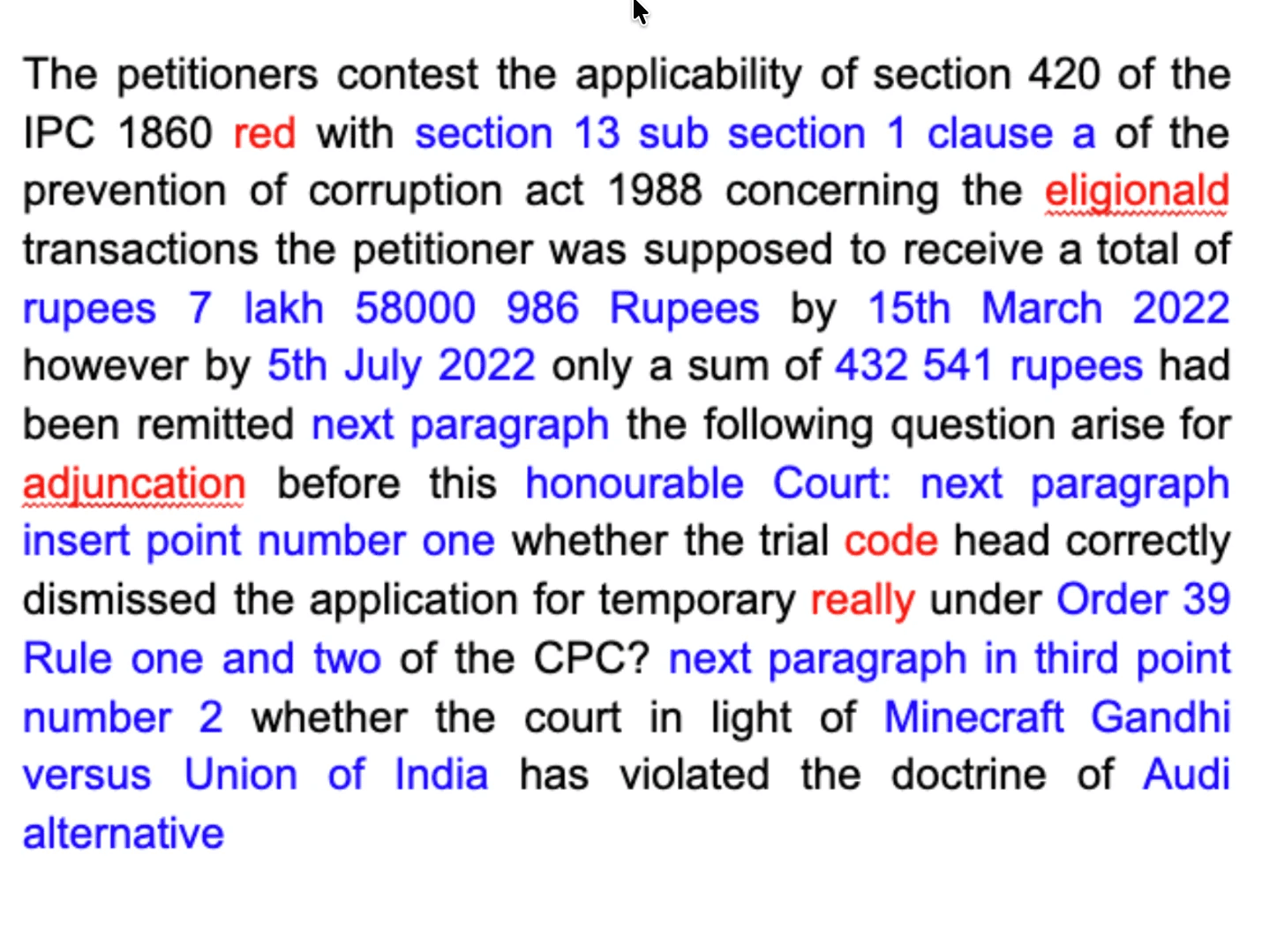 | 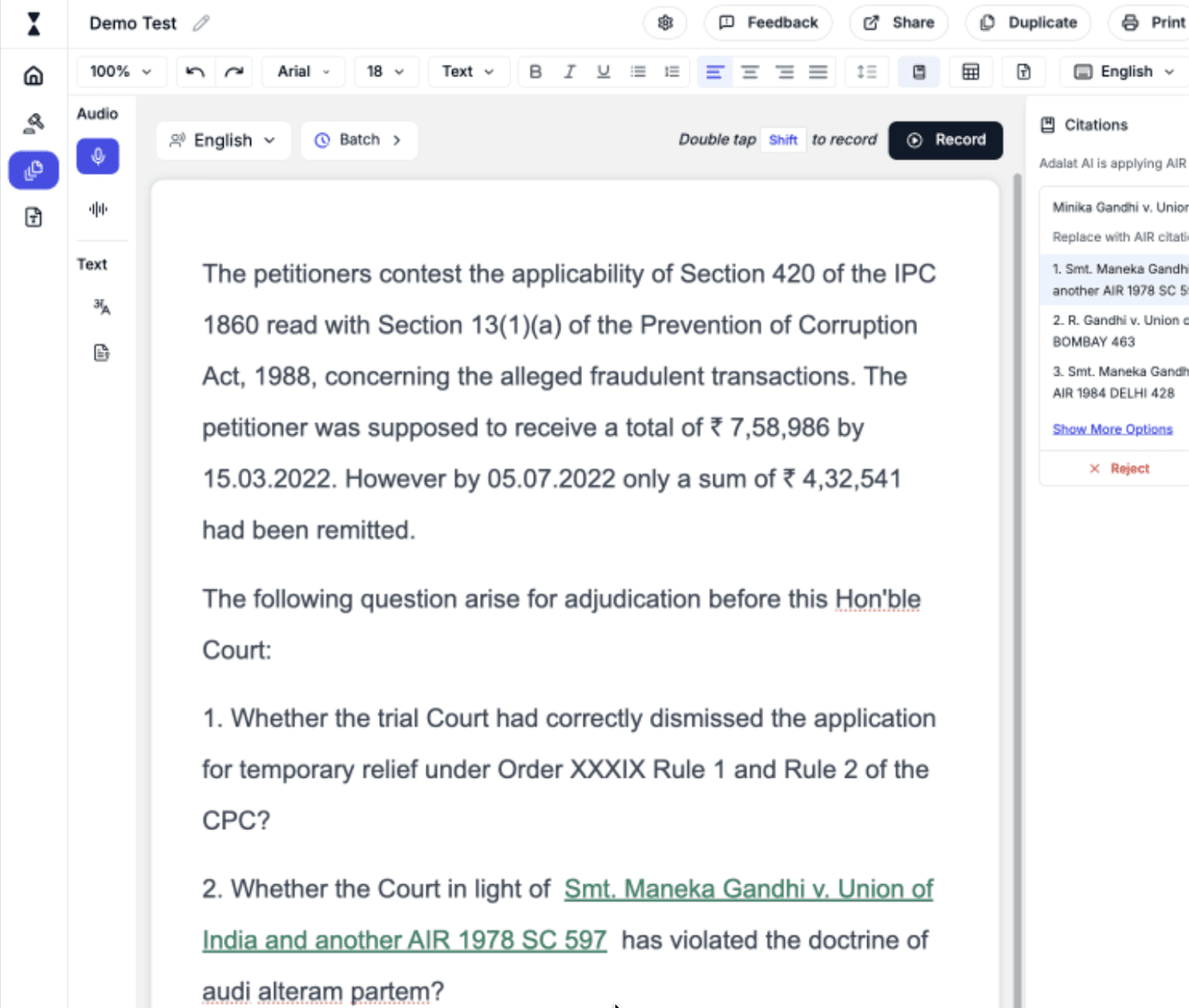 |
A sample legal order dictated simultaneously in a general purpose ASR tool (left) and Adalat AI (right). Adalat AI produced an accurate, well-formatted transcript, while the general purpose tool returned multiple errors. Red text indicates typographical errors; blue text highlights AI capabilities that distinguish Adalat AI from other ASR tools.
In July 2026, we rolled out a new English model (Mynah-en) to a group of power users across the country, including 18 judicial officers in Andhra Pradesh. This model is smaller than its predecessor and has demonstrated improved accuracy in recognising legal terminology, dates and alphanumeric values. A smaller model is beneficial since it processes audio much faster, reduces the lag in transcript generation and demands less GPU power, thereby reducing costs and improving scalability. Mynah-en remains in the pilot phase, but early feedback has been positive. We plan to roll it out to all users before the mandate takes effect on 1 October 2026.
The Telugu speech recognition model has seen similar gains. In July 2026, alongside Mynah-en, we deployed a faster Telugu model developed in response to judicial feedback. It delivers higher transcription accuracy, more consistent spelling, implicit punctuation and better handling of numerals. Continued refinement of Telugu speech recognition remains an active priority for our ML team in the lead-up to the mandate.
Judicial feedback also led to the development of Andhra Pradesh-specific templates for commonly used orders and other judicial documents, making it easier for judges to draft within familiar formats. Andhra Pradesh also became the first state in which Adalat AI was integrated into the High Court’s internal dashboards and official website, allowing judicial officers to access the platform through systems already used for court work.
An important learning from these pilots was that responding consistently to feedback was crucial to building trust and establishing meaningful relationships within the judiciary. Hon’ble Justice Rao Raghunandan Rao, then Chair of the High Court’s Computer Committee, worked closely with Adalat AI, providing guidance at every stage and helping shape the path to the statewide mandate. Following his retirement, Justice Rao joined Adalat AI’s Advisory Board – a testament to the trust built through this collaboration.
Becoming Execution Ready
The success of the pilot has set the stage for the most ambitious phase of our work in Andhra Pradesh yet: preparing the entire district judiciary for the mandate that takes effect on 1 October 2026.
The preparations began on 31 July 2026 with a virtual orientation attended by over 600 judicial officers from across the State. The session introduced Adalat AI and our work, demonstrated the platform in action, outlined the training programme roadmap, and included an interactive Q&A segment. Senior officers of the Andhra Pradesh HC Registry, including D. Yedukondalu, Registrar (IT-cum-CPC), and P. Venkata Ramana (OSD), addressed the gathering, commended the platform and encouraged judicial officers to make active use of it.
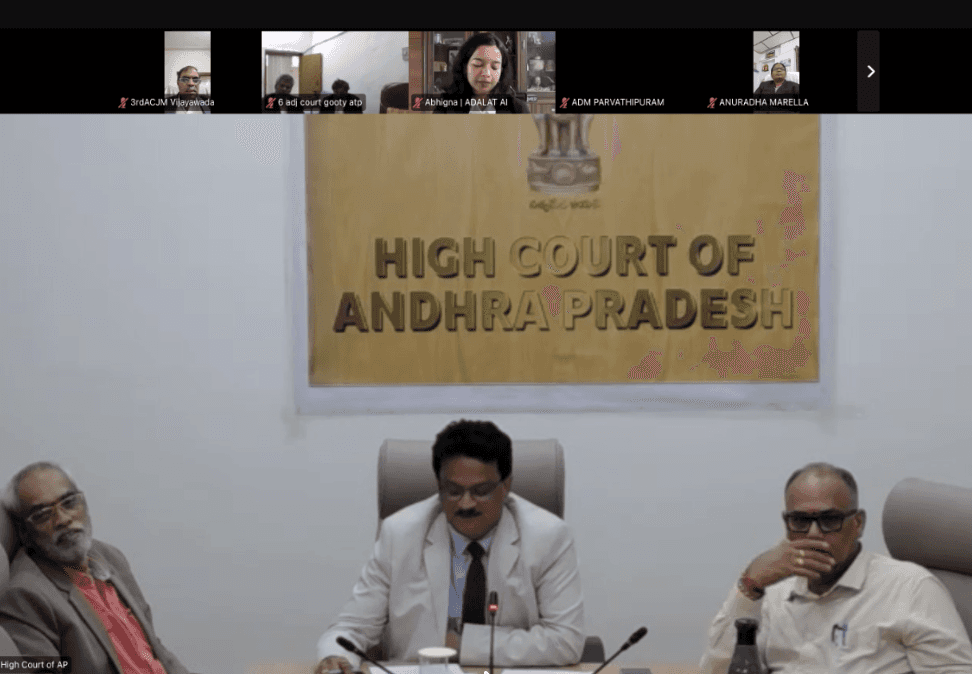 | 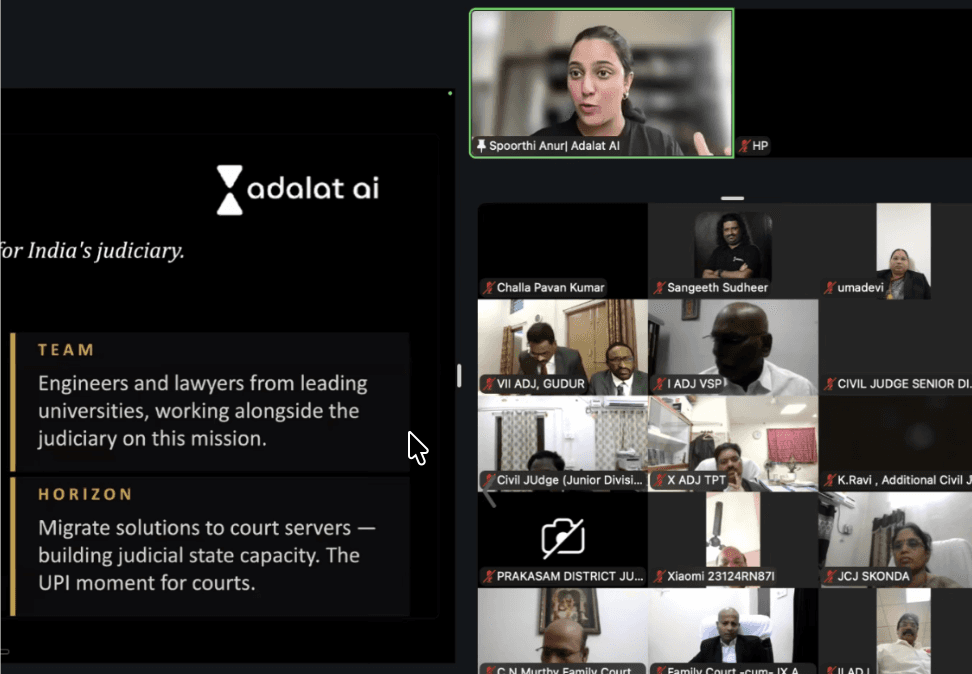 |
Stills from the virtual conference on 31 July 2026, commencing the preparation for the Andhra Pradesh mandate rollout.
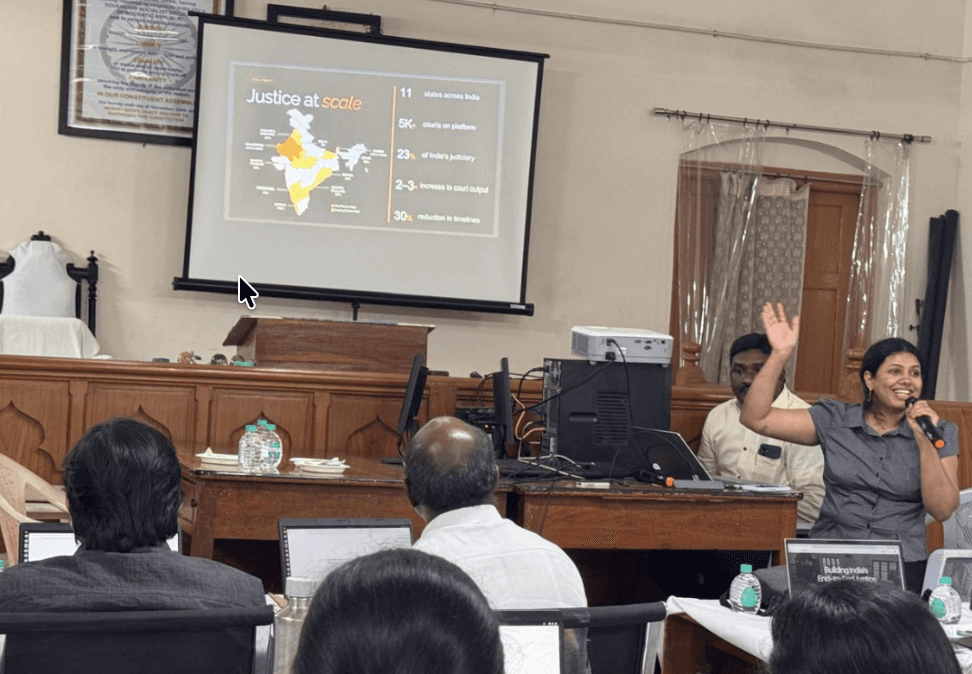
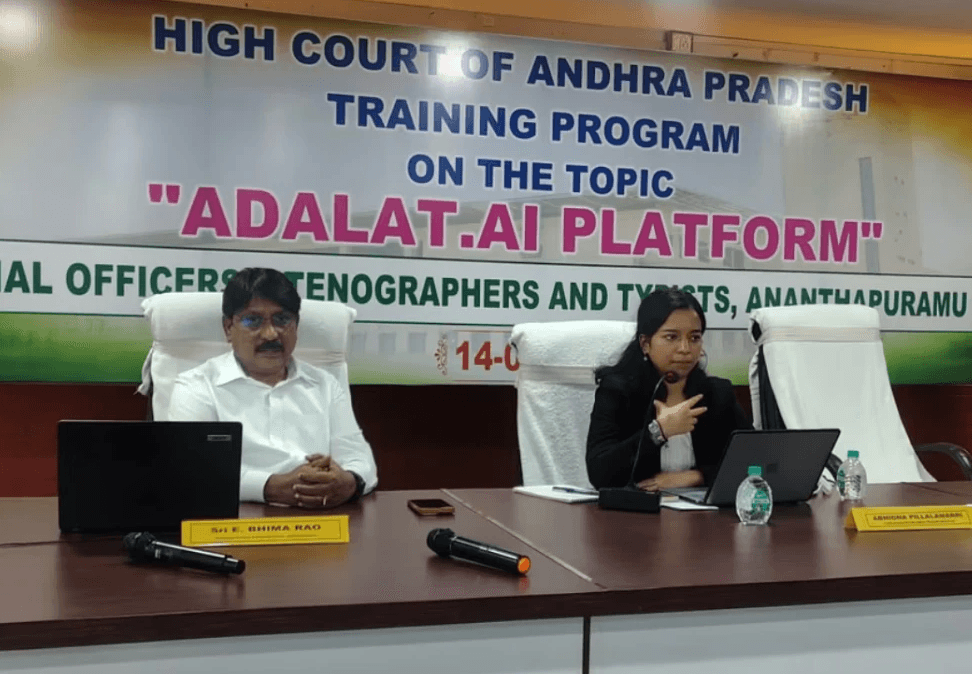
The High Court has also circulated a detailed schedule of online and in-person training sessions being conducted by Adalat AI teams across the State from 1 to 25 August 2026. Now underway, these sessions are designed to be comprehensive, as many of the judges and court staff attending are first-time users. The aim is to introduce the organisation and our mission, onboard users, walk through the product features, test workflows, and resolve implementation issues early.
The early response has been promising. Even in districts that were not part of the structured pilot, we have found that many judicial officers were not only aware of Adalat AI but had already woven it into their daily work. It is encouraging to see judges arrive at these sessions with laptops in hand, working through live workflows rather than watching from a distance. Many officers who have used the platform often come with advanced questions and specific feedback – input that is directly helping our product team refine the user experience ahead of the mandate.
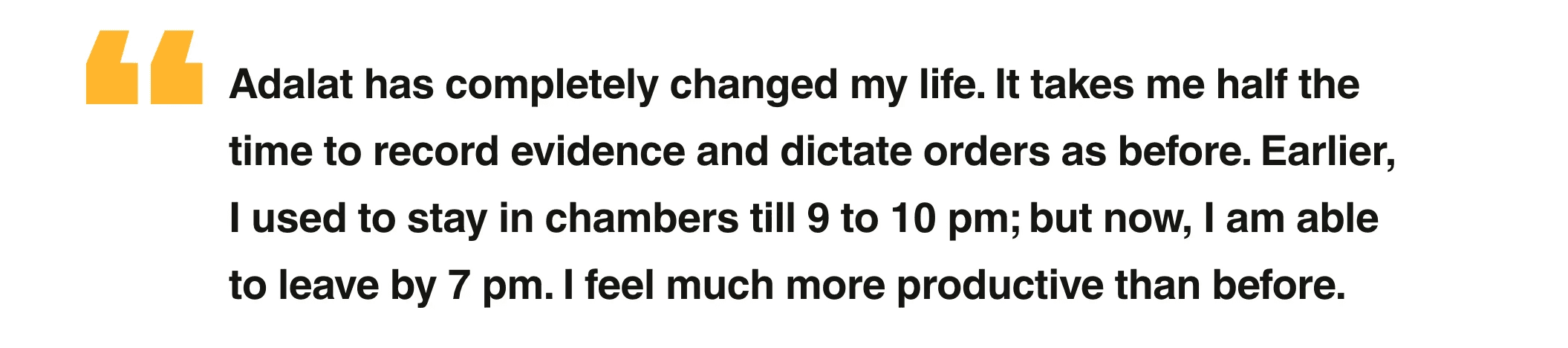
For many, the impact is already tangible. As a Junior Civil Judge from the Srikakulam district told us,
 |  |
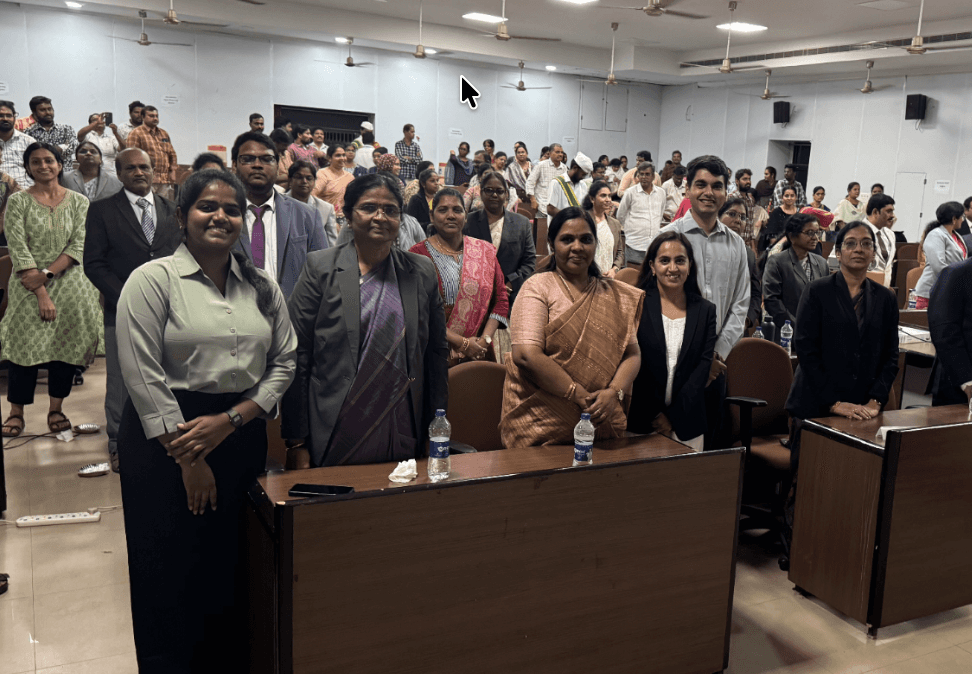 | 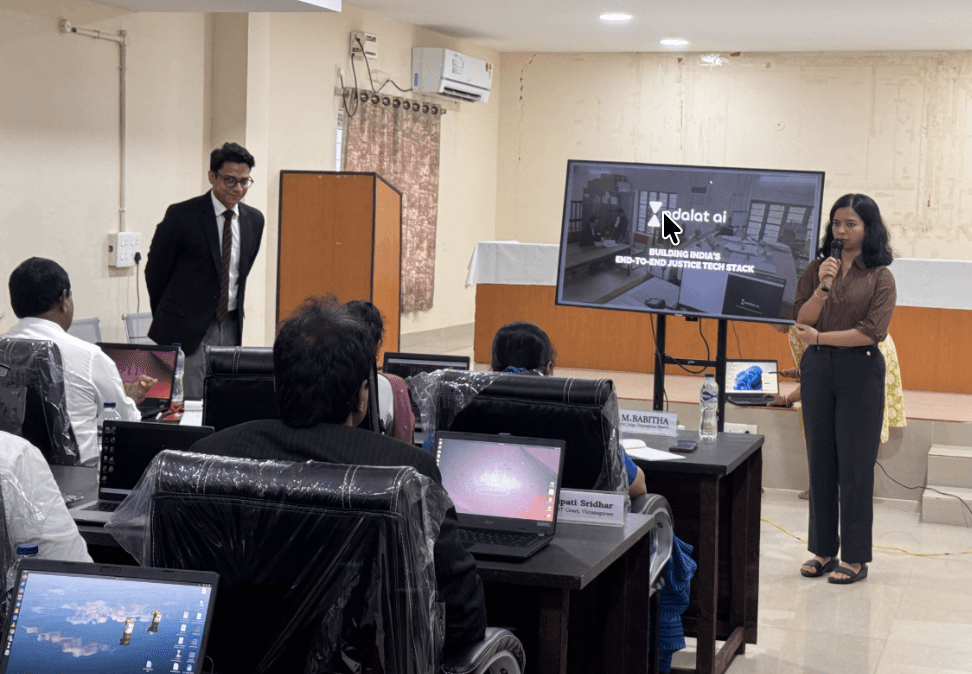 |
In-person training sessions in August 2026 for judicial officers and court staff in (clock-wise from top right) Guntur, Ananthapuram, Vizianagaram and Eluru.
A second set of sessions will follow across September 2026, conducted with all district judges and court staff again. Building on the groundwork laid in the August trainings, these sessions will go further: the Live Court feature will be illustrated in depth, with greater time set aside for doubt clarification as judicial officers grow more comfortable with the platform. Together, the 2 phases are designed to ensure final preparedness before the mandate takes effect on 1 October 2026.
The on-ground efforts will be reinforced by the Master Training Programme, under which 26 selected judges will receive advanced instruction on the platform. Once trained, they will be able to conduct sessions independently and provide context-specific support within their districts. This peer-led model was tried during the pilot in November 2025, when Judge Shaik Shireen ma’am led a session for fellow judicial officers. This session saw stronger participation and growing judicial confidence in the platform, reinforcing the case for scaling the approach ahead of the mandate.
Feedback and Improvement
As adoption scales, we are building on the engagement channels established during the pilot. Our teams will continue to host ‘Office Hours’ for clearing doubts, giving judges and court staff a smaller-group setting to interact with us directly. We have also created a WhatsApp community for judges and court staff, which serves as a channel for questions, product updates and peer support. Users can also share feedback directly through the Adalat AI platform itself. This allows our engineering and ML teams to receive feedback with the relevant workflow context, making it easier to identify and resolve issues.
Alongside these channels, we are conducting a randomised controlled trial across the State, in collaboration with our research partner, the Abdul Latif Jameel Poverty Action Lab (J-PAL) – a research centre co-founded by Abhijit Banerjee and Esther Duflo, Nobel Laureates in Economics (2019), which specialises in generating rigorous, actionable evidence on the effectiveness of technology interventions. This involves surveying judges and court staff to understand judicial workflows and how time allocation shifts before and after adopting Adalat AI. The findings will help us better understand usage and impact, and guide our product and rollout strategy in a data-driven manner.
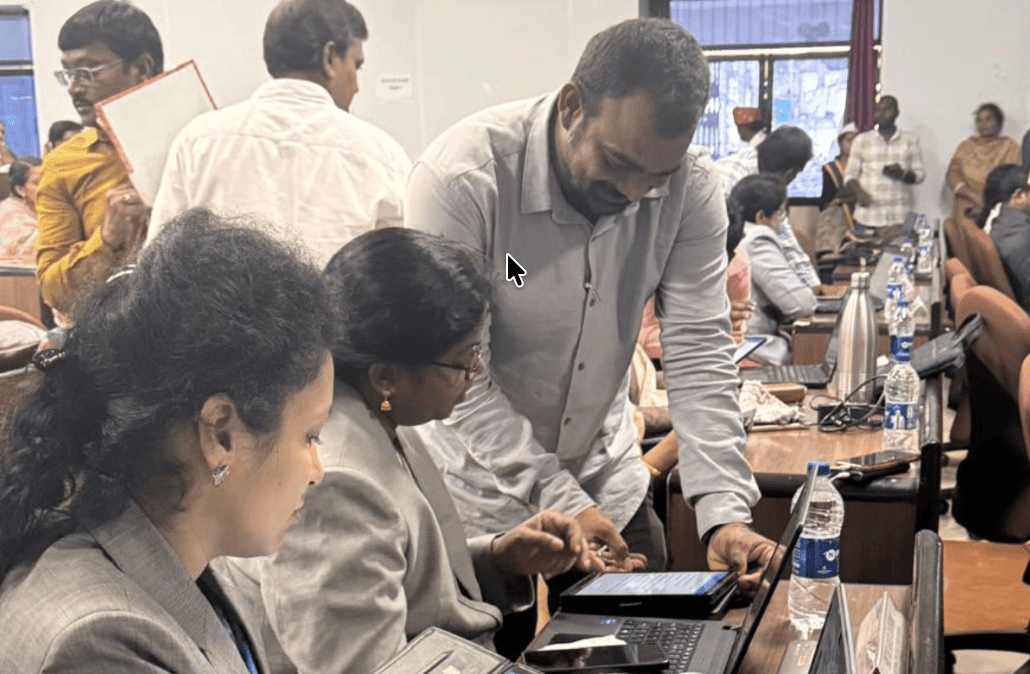 | 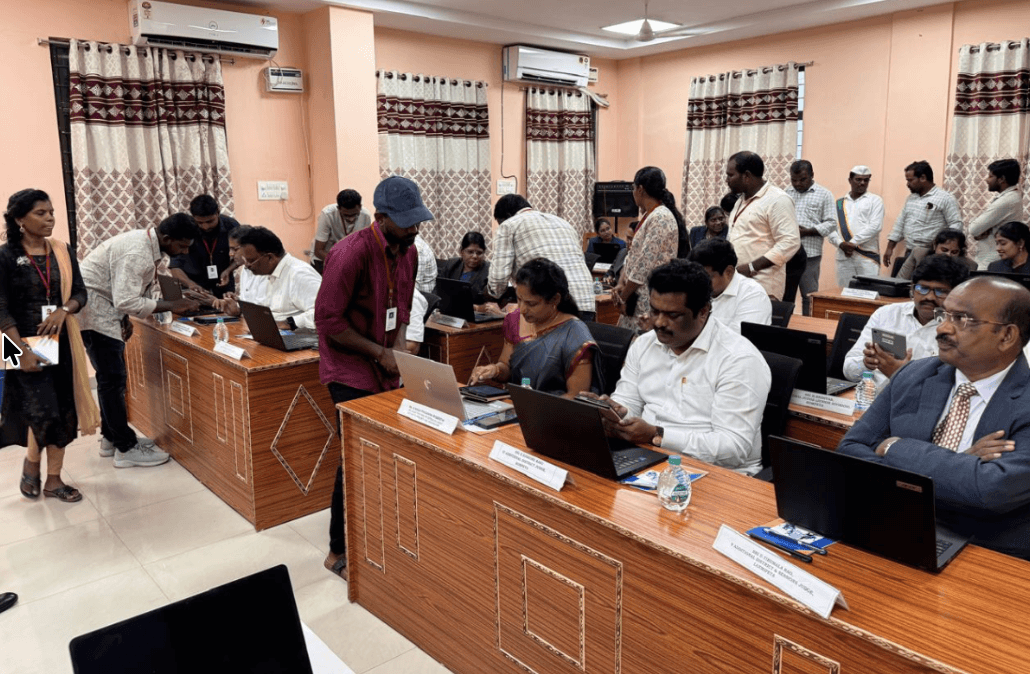 |
Stills from courtrooms in Eluru (left) and Srikakulam (right) where judges are participating in the survey, assisted by the enumerators from J-PAL.
We are grateful to the High Court of Andhra Pradesh for placing its trust in us, and to the judges, Registry officials, court staff, lawyers, researchers, engineers, designers and implementation teams who have contributed to this work. Our focus now is to translate that trust into a reliable and effective rollout across the state.